

A "new" year often comes with motivation and big plans. Then, quietly, uncertainty creeps in. We might feel tense for no clear reason. Our mind keeps jumping ahead. We’re tired, distracted, or slightly on edge even when things look fine, or even perfect, at least on the surface 😥!
The Questions Beneath the Surface
"Why do I feel anxious even when nothing is clearly wrong?"
"How do I stop overthinking when the future is unclear?"
"Why do I feel more anxious waiting for news than receiving bad news?"
If these questions sound so familiar, you’re not alone!
Uncertainty has a way of getting on our nerves. Nothing dramatic may be happening on the outside, yet inside, the alarm in our body starts ringing, our mind runs at 120 km/hr, and our energy drains faster than usual.
Photo by Robert Ruggiero - Unsplash
Why Uncertainty Feels So Uncomfortable
Our brain 🧠 works like a machine which loves patterns. Patterns mean predictability, and predictability feels safe. When the situation becomes uncertain and unpredictable, that "machine" works harder, runs multiple "what if" scenarios, and scans for threats that haven't even happened yet. So, it won't be a surprise that even a negative certainty feels more welcoming than uncertainty. But, while this "machine" has been designed to keep us safe, it creates tension when there is no clear answer and leaves us stuck in an uncomfortable loop.
Here’s a common example.
You arrive at work at 9:00am, open your inbox, and see an email from HR marked “Important.”
Subject line: Announcement by CEO – 3pm today.
Your body tightens. Your thoughts speed up.
Is this about layoffs?
Am I safe?
Should I start looking for another job?
What will happen if I can't find another job?"
………so on and so forth.
You notice how you can't focus on the rest of your work. You are anxiously waiting for 3pm, for the news.
Nothing bad has happened yet, but your nervous system reacts as if it has. Waiting for the unknown can feel worse than receiving bad news. That’s because uncertainty removes our sense of control.
This reaction is often called intolerance of uncertainty. Some people experience “not knowing” as especially distressing, even when there’s no immediate danger.
The Window of Tolerance
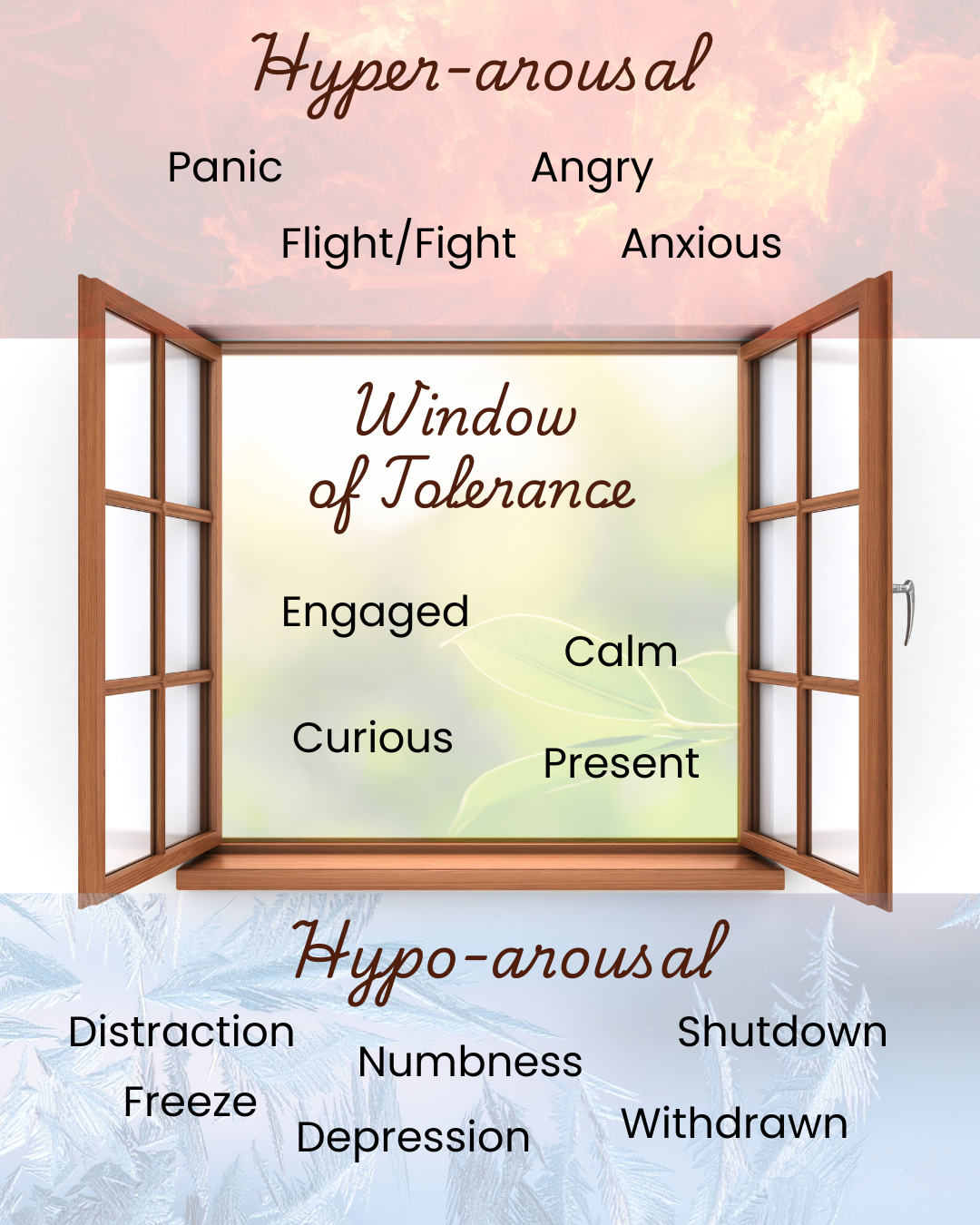
Think of your capacity to handle uncomfortable feelings as a "Window of Tolerance" (Siegel, 2012). When you’re inside that window, you can think clearly, stay present, and handle stress without feeling overwhelmed.
Unfortunately, uncertainty shrinks that window! When the window starts to close, we often find ourselves pushed into one of two states. We might feel hyper-arousal, that jittery, heart-racing anxiety where every email feels like an emergency. Or, we might slip into hypo-arousal, where we feel emotionally "drained", unmotivated, or even a bit numb to the world around us. Both are normal nervous system responses. They’re signals that our system needs support.
According to Siegel (2012), the secret to managing this isn't to force ourselves to stay perfectly calm at all times. Instead, it's about learning to recognize 💡 the moment we've stepped outside our window so we learn to regulate our emotions and return to our Window of Tolerance.
Regulating Emotions in Real Life
Emotion regulation doesn’t require long routines or perfect conditions. Research on emotion regulation shows that we can work with emotions in several different ways, such as shifting attention, changing how we interpret a situation, or caring for our body responses (Gross, 1998).
Think of it as having a toolkit 🛠️, where different tools work better in different situations. At times, even 30 seconds pause and slow breathing, or just noticing and naming what we feel, can shift us back to our Window of Tolerance.
So, instead of being swept away by a wave of emotions, we learn how to surf in the wave 🌊🏄♀️. For example, pausing to say, "Oh, I'm feeling anxious right now because of this email," can reduce the intensity of the anxiety. That moment of awareness creates a space, and that space gives our nervous system a chance to settle before trying to continue with our day.
“Life isn’t about waiting for the storm to pass, it’s about learning to dance in the rain.”
Let's Clear Up Some Myths
Before we dive deep into what to do, let's address some common misconceptions that might be making us feel worse or shameful.
Myth: Feeling anxious means you’re not coping.
Truth: Anxiety is a normal response to uncertainty. The skill is how you respond to it.
Myth: It takes a long time to regulate emotions. When we are busy, we don't have the time.
Truth: Most of the effective techniques take less than 30 seconds. It'll take just a single deep breath and brief pause.
Myth: Emotions don’t belong in professional settings.
Truth: Emotions are information. Like a dashboard, they signal what’s happening and can help in decision-making.
Myth: Calm people are born that way.
Truth: Staying calm under pressure is a learned skill. It requires practice, self-awareness, and the right techniques.
Myth: If we stop thinking about the uncertainty and challenges, we are being irresponsible.
Truth: Rumination is not planning. Rumination repeats the same worries. Planning has next steps.
Myth: Emotional intelligence is something we're born with. We either have it or not.
Truth: It's like a muscle. It gets stronger the more we intentionally and consciously practice "pausing" before reacting.
Myth: You need certainty before taking action.
Truth: We usually need small actions first. The small actions slowly build the clarity.
What You Can Do Right Now
Try this when uncertainty feels overwhelming.
Take a piece of paper and draw two circles or columns.
Circle/Column 1 🟢 : Within my influence or control today.
Examples: preparation, effort, boundaries, skills, priorities
Circle/Column 2 🔴 : Outside my influence or control.
Examples: other people’s reactions, timing, outcomes, the economy
Choose one small action from the first circle or column, and do it within 24 hours.
Then, give yourself permission to stop problem-solving what’s in the second circle.
From Uncertainty to Action
Want to take it a step further? Try this short exercise.
Note: Do it twice a week (once on a weekday and once on a weekend) for a month.
Write one uncertainty you are facing right now (in one sentence). Example: The outcome of my performance appraisal at the end of February.
Write one feeling/thought you notice and describe it (in one sentence). Example: I am worried about how my boss will appraise me.
Do the two circles 🟢🔴 practice. Example: First circle: I'll prepare my KPI submission the best I can do. Second circle: Tell myself that I won't know how my boss will react, so I need to accept this fact.
Do the action from the first circle within 24 hours.
Be patient with yourself.
While uncertainty is part and parcel of life, it doesn’t mean we’re stuck.
Give yourself the time and space to slowly return to your window of tolerance.
so we can choose how to respond to the unexpected curveballs that work and life throw at us.
You've got this!
Siegel, D. J. (2012). The Developing Mind, second edition: How Relationships and the Brain Interact to Shape Who We Are. Guilford Press.
Gross, J. J. (1998). The Emerging Field of Emotion Regulation: An Integrative Review. In Review of General Psychology (Vol. 2, Issue 5, pp. 271–299). Educational Publishing Foundation. https://emotion.wisc.edu/wp-content/uploads/sites/1353/2024/11/gross-1998-the-emerging-field-of-emotion-regulation-an-integrative-review.pdf


